
Cloud Gaming Atlas
A visual rendering for the analysis of green gaming infrastructures
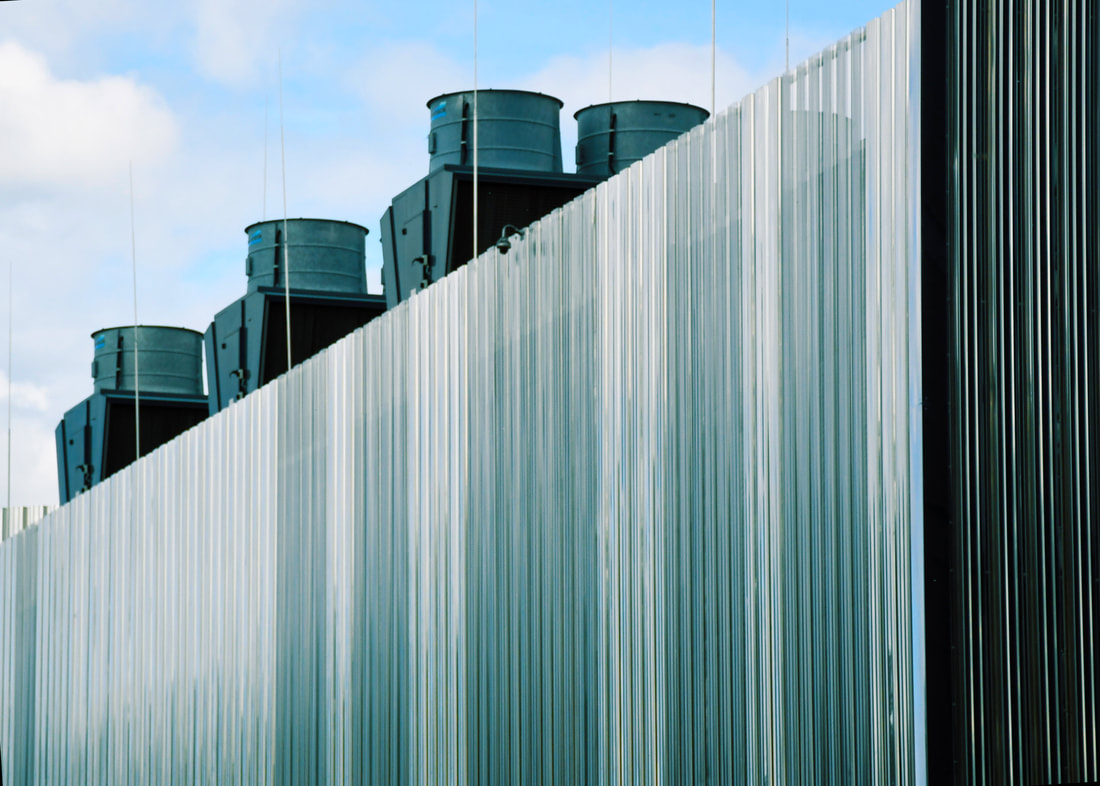 We will start 2024 with a workshop at the University of Potsdam. In 11.01.24 we will put up the event at the Brandenburgisches Zentrum für Medienwissenschaften (ZeM), as part of my research visit at the chair for Knowledge Cultures and Media Environments.
The workshop proposes an open discussion on the relationship between cloud infrastructures and environmental issues, in light of emerging cloud gaming services and other computer-intensive media platforms. The imageries surrounding digitalisation have been largely associated with ideas of green growth, energy transition, and resource efficiency, while at the same being conceptualised within a post-industrial epistemological framework that envisioned digital media as cold, ephemeral, or weightless. However, by analysing reports from monitoring organisations, as well as the very physical structures that make platform services possible, one can trace some of the frictions in the environmental imagination at the heart of ambient supercomputing. The scale of these technical systems also poses challenges to perception and visualisation: it is not only that the sheer volume of data they carry is difficult to conceive. With the outsourcing of computer processing and storage to geo-distributed facilities, planetary-scale cloud infrastructures convey the prospect of ubiquitous telematics yet opaque industrialisation, showing and concealing at once. After an impulse talk on the topic, we would like to jointly discuss the interplay between these infrastructures and environments, as privileged spaces to observe the merging of the inorganic with the organic in telematic technical systems. Anyone interested in joining us can register by sending an email to [email protected].
0 Comments
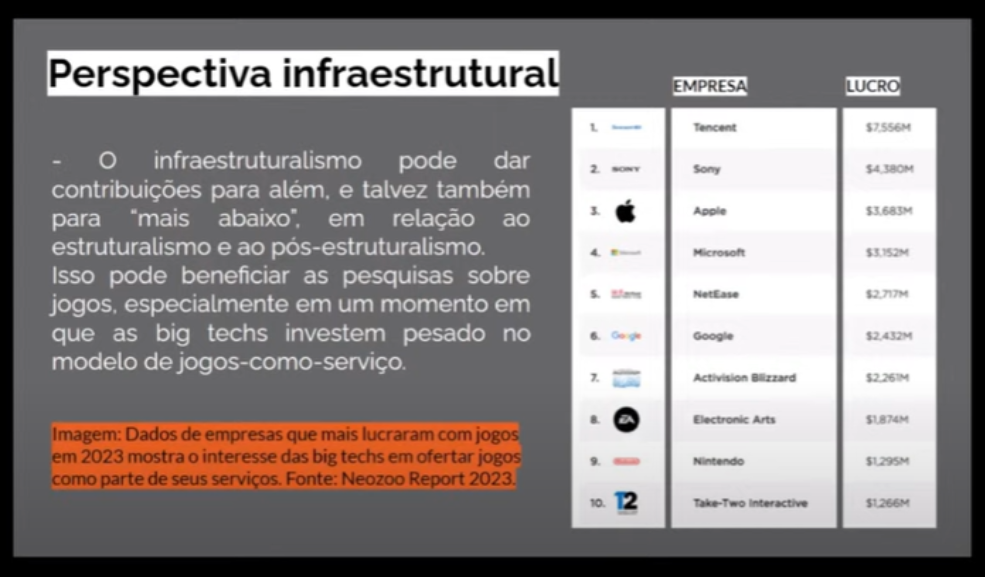 Last week I returned home for a couple of hours, at least metaphorically, by presenting my current research at Semana da Imagem, an event that the TCAv group has been organizing annually at Unisinos for more than two decades now. The research seeks to connect game studies and Earth systems, by analyzing the environmental entanglements of the computing-intensive infrastructure that supports, among other things, cloud gaming platforms. I present some cases to demonstrate how platforms are mediators not only of so-called "content", but of thermal processes that are intertwined with it. This approach seeks to tackle a conceptual problem: the usual imagination of media as dematerialized forms. The main argument is that, just as important as practical mitigation and reduction strategies, is the initiative to take a step back (literally to the background) epistemologically, to better understand the infrastructural relationships that mediate these interactions, which shape how games and other digital services circulate around the world. After all, if present-day media assemblages enable information exchange on a global - albeit asymmetrical - scale, the heat exchanges mediated by them also entail a planetary outcome.
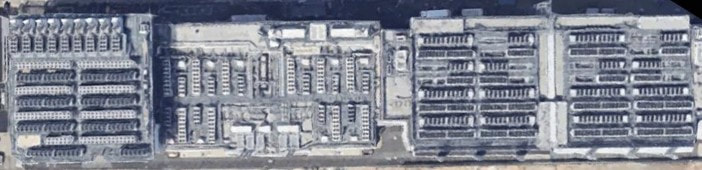 As parts of the gaming sector merge with the carbon-intensive metabolism of the cloud, where outsourced heat is incorporated into business as usual, one could argue that planetary health is not really one of the industry's priorities--at the same time, several environment-oriented initiatives are carried out by actors involved in game developing and publishing.
In a presentation next Friday at the Future and Reality of Gaming conference, I will inquire about these and other contradictions in the current sustainability measures adopted by the games industry, while trying to tangle up a dynamic ecosystem of servers, biomes, computers, animals, trade, air-conditioners, video cards, groundwater, and real-time photo-realistic rendering. You can access the abstract of the paper and the full conference programme, which is oriented towards studying the relationship of games and money. 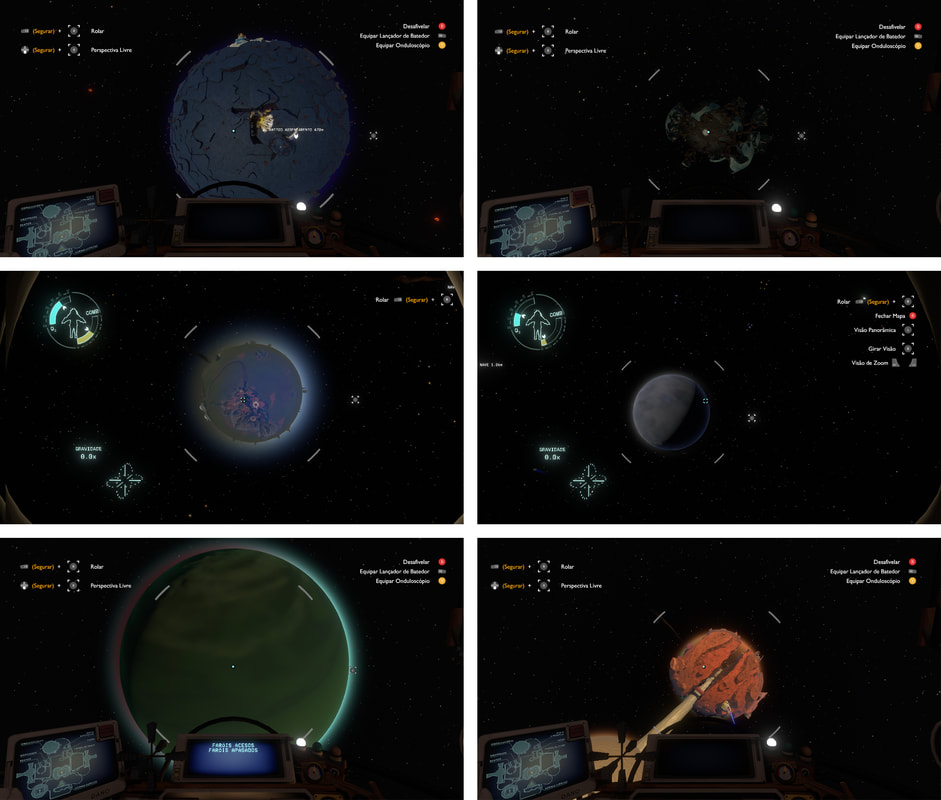 Outer space has been recurrently represented in computer games. This phenomenon can, in part, be attributed to the immersive and simulation-oriented nature inherent to the digital gaming medium. Computer simulation provides designers with a vast and flexible canvas upon which they can meticulously craft highly imaginative topographies and scenarios, and one could propose that the coupling of digital games and space science fiction is a perfect match for developing speculative aesthetics. Nonetheless, the relentless repetition of warfare and space colonisation themes in digital games can sometimes make the wondrous imaginings about outer space look pretty dull and boring.
Some developers apparently understood this difference, and seem to explore the elements that connect space exploration and human curiosity in particular. This is the case of Mobius Digital's game Outer Wilds. As a creative game about exoplanet exploration, Outer Wilds promotes some significant but often neglected aspects of space travel in contemporary sci-fi, from the cosmopolitical dimension necessary to produce open knowledge about the universe to the scientific methods developed to assemble images of unknown spaces thousand light-years away. In Outer Wilds the cosmos is not primarily a space for restaging civilisational clashes or highlighting geopolitical disputes. Instead, players are lured to explore the surrounding planetary marbles while waiting for a supernova that will successively reconstruct the universe at each interval of 22 minutes. In an article recently published on Games and Culture, Julieth Paula and I discuss these and other aspects of the space-themed game, while retrieving the media imageries of space exploration and the effects of observational astronomy over media philosophy under Peter Szendy's notion of philosofiction. ps.: The article has also some nice-looking screenshots from the game as well.
The article I wrote with Bibiana, as an extension of her work on gambiarra practictioners into a media-ecological perspective, just got published! 'Gambiarra and the In(ter)dependent Condition: Ecological Relationships in the Construction of Experimental Musical Instruments' is out on Resonances, a sound studies and musicology journal published by the University of California Press.
The piece deals with the creative practices employed in the construction of alternative musical instruments, as observed in the works of the Indonesian experimental duo Senyawa. We analyse how the artisanal reutilization processes of “gambiarra” are interwoven with geographical spaces, technical habilitation, infrastructural conditions, and local resources. At the same time as we demonstrate how the gestures of ingenuity and adaptation involved in gambiarra practices put forward a sort of applied, interdependent techno-cultural rationale, we highlight how the recurring romanticization of the prevalent infrastructural problems often present in such contexts can be detrimental. This perspective, drawn from an analysis of everyday practices of instrument-building, intends to surpass the fetish often observed for these informal solutions and the common interpretation of gambiarras as means of socio-economic disruption. In analyses withdrawn from everyday practice, this recurring idealization of precarity can be politically weaponised, and may end up being used to justify austerity as a means of moral and material prosperity. More modestly, we argue instead that as an experimental practice gambiarra intrinsically engenders an interdependence principle, and can lead to fruitful insight into the epistemic connections between environmental and infrastructural thinking. An open access version of the article can be read at the institutional repository of the University of Konstanz (KOPS): https://kops.uni-konstanz.de/entities/publication/3367b81a-6ab4-422e-8ffc-fafa2f518c3b 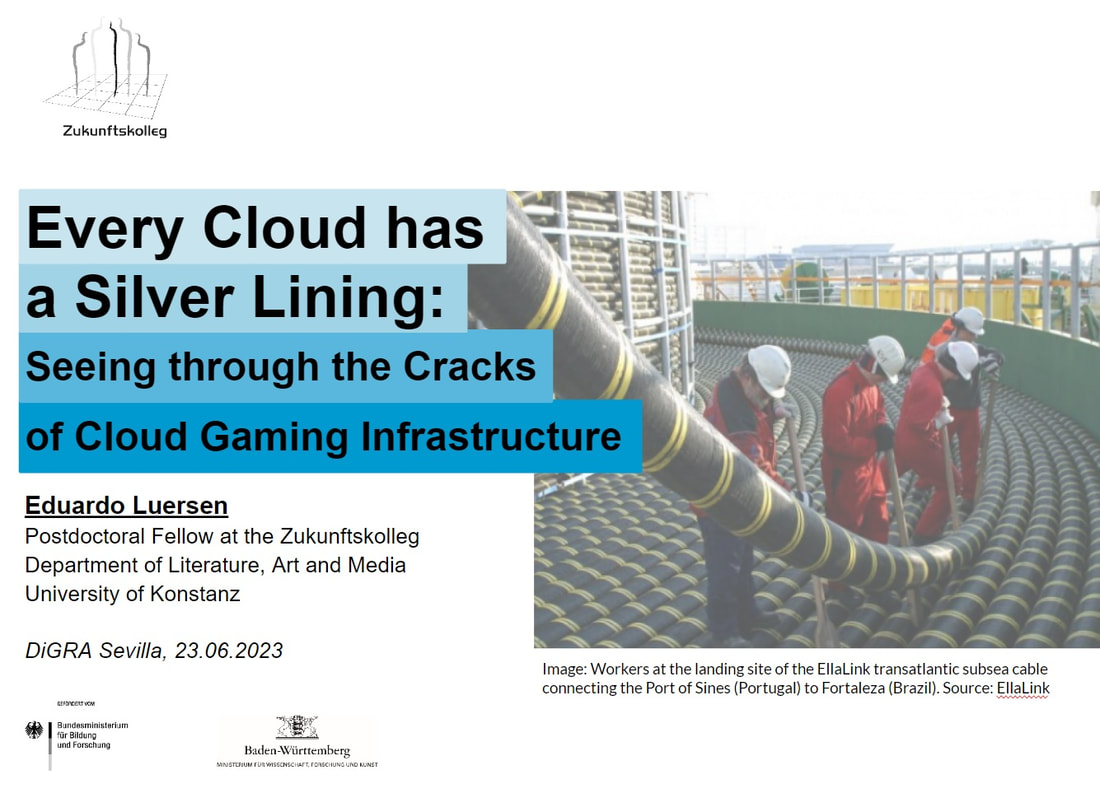 Just arrived from my first participation in an international DiGRA conference. Lovely time with colleagues from the game studies community! DiGRA is the major international association for scholars and practictioners who research digital games and associated phenomena. I presented my paper (as you see on the image) in a session about "Digital Data Clouds". The session was chaired by Martin Roth, who had plenty to contribute to the discussion, and I was glad to present my piece just before Darshana Jayemanne, Stuart Anderson, Heikki Tyni and Olli Sotamaa presented theirs. It was the second time I had the opportunity to attend to a presentation from Heikki and Olli, and I find very productive resonances between our projects. In my talk I proposed to explore gaming from a media infrastructure studies perspective, articulating why I think this is an important approach at the moment, especially considering the case of cloud gaming infrastructure, how it failed so far, and how it is currently being developed. As I was kindly provoked by one of the peer reviewers of the conference to show what could be the practical contributions of this approach to Game Studies, in the second part of the presentation I also suggested three particular methodological contributions that media infrastructure studies could make to research on gaming. In the final part, I pointed out why I think the phenomenon of cloud gaming should be observed through interdisciplinary lenses. 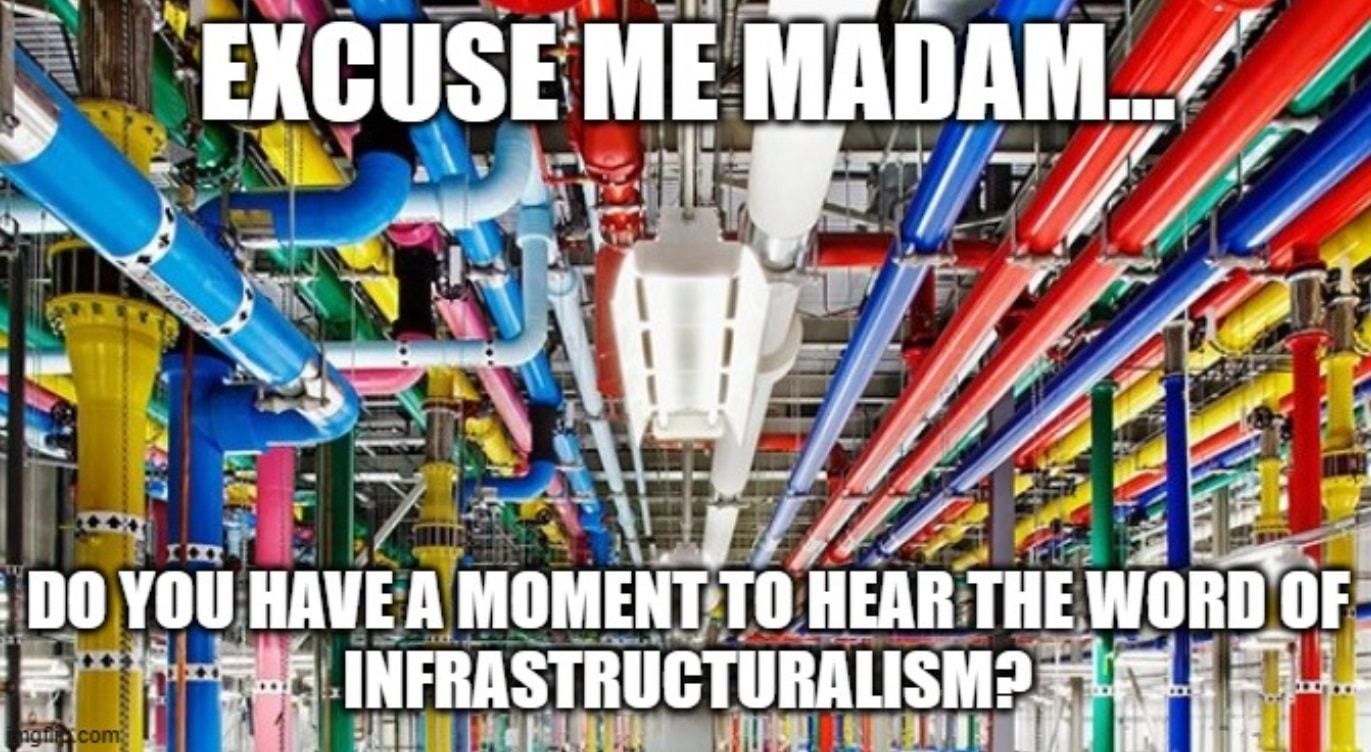 In order to spur a debate on the subject, I argued that the successive failures to implement cloud gaming under a platform business model opened up a paramount opportunity to entangle the research on digital games with media infrastructure studies (Starosielski 2015, Parks and Starosielski 2015, Plantin and Punathambekar 2018), and in particular with the media-philosophical perspective that Peters (2015) calls "infrastructuralism". On the level of infrastructure, these entanglements encompass not only the technical milieu of digital platforms but also associated regulatory, bureaucratic, environmental and geopolitical issues. For instance, the transnational companies providing scalable cloud gaming services have to cope with nationwide, locally-based energy providers or build their own facilities to supply their demand from local resources. At this level, challenges touch the more substantial layer of critical infrastructure, energy sourcing and natural resource management.
To understand the sociotechnical complexity of gaming infrastructures, one should also consider how the energy metabolism sustaining cloud gaming services involve matters of political geography. As historian of technology Per Högselius (2018, 10) puts it, “the geopolitics of energy is not only about the energy that is in and on the Earth – fossil fuels, uranium, forests, winds and waves. It concerns the long-distance movements of energy”, encompassing the pipelines, ships and transmission towers needed to establish an efficient trade chain, as well as the places where energy in its diverse forms is produced, refined, stored and consumed. As digital gaming also involves significant geoeconomic assets, its study should not disregard the interplay of geopolitics and energy infrastructures that enables the practice as a habitual, planetary-scale communication technique. Therefore, interdisciplinary perspectives become necessary to better understand how the phenomena of cloud gaming intermingle with the sociotechnical underpinnings of contemporary societies. This June I complete one year of residence in Germany. One year working on the Cloud Gaming Atlas project, among many other things! 2022 was a year full of work done on research, but I also had many usual administrative and bureaucratic task connected to my relocation to Europe, and Konstanz in particular. This lead me to engage less than expected in collaborative research and academic cooperation. Fortunately, in 2023 I am being able to catch up with these expectations, and do far I have been accepted as a member in three promising working groups, with which I wish to collaborate in the mid and long run.
Working within the University of Konstanz, I joined the Centre for Human | Data | Society, which is dedicated to understanding how digitalization and datafication affects social system(s) and individuals alike. The centre seeks to critically reflect and recalibrate the long-standing concepts of agency, autonomy and accountability in order to acquire a broader understanding of datafication as a means of knowledge production in a data-driven world. I was also invited to become a member of the Global Internet Governance Academic Network (GigaNet). The network groups researchers interested in a wide range of practices involving policy and governance of the technologically mediated processes of digitisation and datafication, including issues related to platform governance, big data, the values, power structures, and geopolitics of technology. Finally, I was also accepted as a member of the Working Group on Games (AG Games) of the Gesellschaft für Medienwissenschft (GfM). As an interdisciplinary association of researchers based in Germany, the group has set itself the goal of systematizing the scientific discourse on digital and analogue games and promoting it both theoretically and empirically. The umbrella of subjects explored by each of the three groups speak to different aspects of the Cloud Gaming Atlas, and will hopefully contribute not only to the multi-faced epistemological progress of the project, but also in building stronger international networks and nurturing long-term academic associations.
"In mountainous regions, trees above the cloud line are sometimes invisible from the vantage point of cities in the valley below. Sometimes it looks as if the gray sky has decapitated the peaks. But for the Cloud layer, what is invisible is less what is above than what is below the point where the computation touches the ground. Unseen but not placeless, the trans-urbanism of the Cloud layer is defined not just by the distribution of terrestrial borders, but also by the terraforming recentralization of nodes — urban, financial, logistical, political — in the service and purpose of its networks (e.g., former Siberian missile command bunkers are turned into icy data centers, and entire skyscrapers in downtown Los Angeles are turned into massive, stacked switching hubs for every major telco by CoreSite/Carlyle Group). Above ground, the Cloud makes its own kind of temporary logistics plantations at exurban perimeters or near, or indeed inside, regional airports. The warehouse and supply chain centers that turn commands in databases into the traffic of real goods constitute a shadow network of itinerant packages and only slightly less itinerant laborers. Amazon and Walmart’s fulfillment centers in places like Hebron, Kentucky, Goodyear, Arizona, and Fernley, Nevada, are staffed by a multitiered outsourced and re-outsourced population of sorters, packers, and movers. During Christmas, when demand for short-term labor is acute, Amazon will make use of “ workampers, ”often senior citizens moving in large recreational vehicles from one fulfillment center to another, coming and going from Amazon towns as demand dictates. Guest workers of the algorithms: Grandpa, the Wandering Morlock of The Cloud. 9 Here we glimpse the prototype of a future Cloud feudalism."
Bratton, 2015, p.111 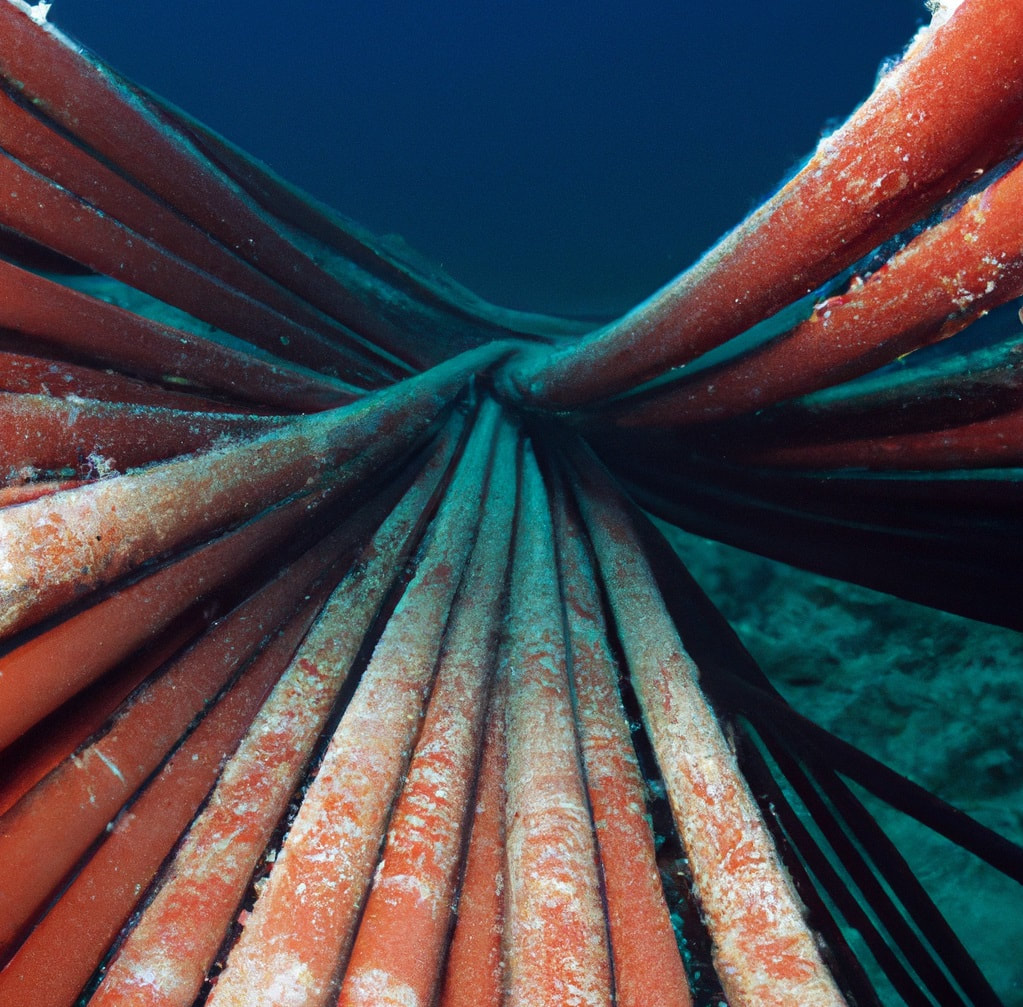 Reliable internet connection is an obvious important issue nowadays, whether for economic, geopolitical or cultural reasons. In a time when media industries are strongly relying on a platform service model based on streaming content, access to global cultural assets becomes strongly constrained by the infrastructure of connectivity. Still this day, due to historical traits of infrastructure development, providing connectivity to certain regions can be challenging, especially in the Global South, and companies in the tech sector have been struggling to stretch their operations to previously inaccessible locations. Google’s recently failed project Loon, for instance, sought to release helium balloons to the stratosphere in order to provide internet access to unconnected areas. Google’s parent company, Alphabet, is now investing in project Taara, a similar attempt to relay internet signal to regions without previous internet infrastructure through light beams. SpaceX launched their Starlink satellites with the same purpose, whereas Meta also had a project to connect the unconnected via satellites and solar-powered drones.
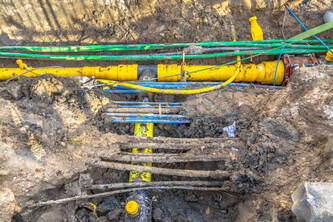
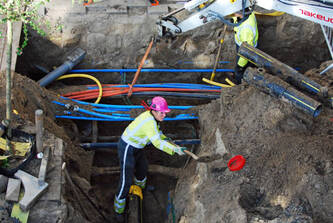
Although often engulfed by scenic imageries of the sky’s vastness and dreams of widespread connectivity through the air, most of the internet and cloud computing actually depend on very terrane and even submarine infrastructure. This is also where most of the more grounded efforts to take networked computing to still unconnected locations or to enhance the already existing infrastructure take place. In order to transmit information securely and reliably, 98% of international internet traffic is carried through the vast underwater network of submarine cables. Undersea cables are normally owned by consortiums of owners, who are responsible for costs associated with laying and repairing undersea connections. Recently in 2021, GlobeNet provided a transatlantic cable connection, the EllaLink cable, stretching 6,000 km between Fortaleza (Ceará) and Sines (Portugal), offering advanced IT infrastructure and low-latency routes between European and South American companies and users. This is highly relevant for the Gaming industry, for instance, which has been trying to establish cloud gaming platforms and nurture a user base for streaming service models unsuccessfully for more than fifteen years now. It is promised that EllaLink will be able to provide a connection with 30-50% less latency for gamers playing across the Atlantic (50% for users in the Northeast region of Brazil in comparison to 30% in the Southeast, as the signal has to travel in milliseconds a distance of more than 2000 km). This is a significant step for the establishment of cloud gaming services, a model which has been struggling to provide solid services for more than a decade now. The connection is very promising as an expansion of European game services to a multitude of new users, but it can also be an opportunity on the other way around for Latin-American game developers and platforms in the digital economy. Furthermore, it also allows us to see how gaming and other digital activities are always already traversed by issues of political geography and national interests. For more than twenty years there were no practical direct data transfer routes between Europe and South America. Atlantis-2, the cable linking the two continents, was not used for data transfer due to its limited capacity. Issues of sovereignty were alleged when the project to build the EllaLink cable started, as the connection could potentially allow circumventing the NSA-based surveillance program PRISM through a cable route connecting Europe directly with South America. Back in 2014, then President of Brazil Dilma Rousseff said that the EllaLink connection would be central to "ensure the neutrality" of the Internet, with the possibility of denying access to Internet traffic in Brazil to national government activities of the US. The Cloud Gaming Atlas project joins the Zentrum für Kulturwissenschaftliche Forschung (ZKF)2/14/2023 Just before the end of the year my application to join as a member of the Centre for Cultural Inquiry of the University of Konstanz was accepted. I already took part in a set of outstanding initiatives put up by the institute in 2022, such as the 3-day workshop "Rethinking Infrastructure" and the public talk "Several Infrastructures of Weather and Climate", by John Durham Peters. I am already looking forward to a new year with new opportunities for cooperation and joint initiatives at the institute.
https://www.uni-konstanz.de/forschen/forschungseinrichtungen/zentrum-fuer-kulturwissenschaftliche-forschung/kontakt-personen/mitglieder/ |
AuthorThis blog is meant to provide a space for discussing the geophysical as well as the the imaginary entanglements between media infrastructures and organic environments. In the coming months, it will be dedicated to my current project, Cloud Gaming Atlas, which is particularly interested in observing and interrogating the infrastructures developed for cloud gaming initiatives in regard to their environmental implications. Additionally, it should also gather information about events and publications related to my project at the Zukunftskolleg and the Department of Literature, Art and Media of the University of Konstanz. Archives
January 2024
Categories |

 RSS Feed
